
What You Need To Know
The 21st Century Cures Act, Information Blocking Rule mandates that patients have rapid, free and full access upon request to test results, medication lists, referral information, and clinical notes, all in electronic formats by default. For HMH this means that the record is immediately available in MyChart. The two banners will read as follows:
Periodic review conducted by the HMH Office of Privacy continues to identify non-compliance of the 21st Century Cures Act, Information Blocking Rule compliance; specifically the Epic Do Not Share functionality.
- Complying with the information blocking rule is "imperative", it is a legal requirement that prevents healthcare providers from intentionally hindering the access, exchange, or use of electronic health information (EHI), which could lead to significant penalties for non-compliance, including potential fines and legal repercussions, while also ensuring patients have timely access to their medical records across different healthcare systems; essentially, it is crucial for patient care and data sharing within the healthcare industry.
The "do not share information blocking rule" refers to a situation where a healthcare provider or entity repeatedly engages in practices that intentionally hinder the access, exchange, or use of electronic health information (EHI), even after being notified that their actions constitute information blocking, potentially leading to increased penalties due to the ongoing nature of the violation.
The DNS functionality and the permitted exceptions:
Epic Do Not Share Functionality
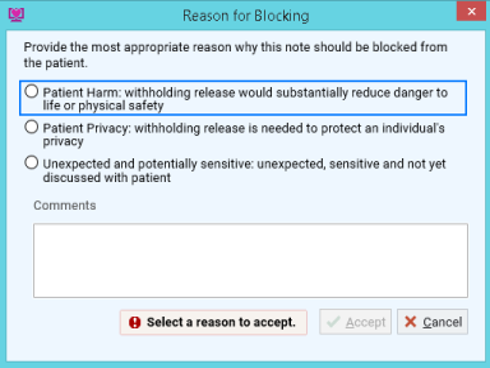
In very limited circumstances, if the Note meets an “exception” under the Rule, a provider can take steps to prevent a note from being shared via choosing the Epic Do Not Share functionality. Three of the exceptions are available in Epic and must be evaluated on a case by case basis. There is a hard stop in Epic and the Provider will be required to document the reason for not sharing the note with a patient.
The three reasons for not sharing available in Epic include:
Disincentives Enacted
On June 24, 2024 HHS issued its final rule regarding disincentives for eligible hospitals or critical access hospitals, clinician groups and accountable care organizations (ACOs) found to have committed information blocking, The Office of Inspector General (OIG) within HHS is responsible for investigating and enforcing information blocking violations. If the OIG determines continued violation of the information blocking rule has occurred, the entity could face significant penalties related to Medicare reimbursement, limitations on participation in certain programs, or public disclosure of information blocking violations civil monetary penalties, potentially reaching up to $1 million per violation, financial disincentives that could negatively impact HMH.
References
https://www.healthit.gov/topic/information-blocking
Final Rule, 85 Fed Reg. 25642 Section VIII(D), pages 25820-25900.