
What You Need To Know
Summary
Acute flaccid myelitis (AFM) is a rare but serious neurologic condition that affects mostly children and typically presents with sudden limb weakness that can lead to permanent paralysis. Surveillance for AFM in the United States began in 2014 when a large increase in cases was first identified. After 2014, reported cases of AFM peaked in 2016 and 2018, with the greatest number of cases occurring during late summer and early fall. Clinicians should consider AFM in patients with acute onset of flaccid weakness, especially between August and November, to ensure rapid hospitalization and prompt referral to care. Recent respiratory illness or fever and the presence of neck or back pain or any neurologic symptom should heighten suspicion of AFM. Clinicians are encouraged to report suspected cases of AFM. Reporting of cases will help states and the Centers for Disease Control and Prevention (CDC) monitor the occurrence of AFM to better understand factors associated with this illness. Of note, the July 2022 case of paralytic poliomyelitis in New York was identified because a clinician recognized the patient met the reporting criteria for AFM and submitted specimens as part of AFM surveillance, resulting in the detection of poliovirus. This underscores the importance of remaining vigilant for possible cases of AFM and reporting them to the New Jersey Department of Health (NJDOH).
Background
In August 2014, the CDC began investigating and tracking cases of AFM. Since that time, a total of 758 confirmed AFM cases have been reported nationally. Even though it is uncommon, increases in cases have been noted in 2014, 2016, and 2018, mostly in young children. It is unclear when the next increase in AFM could be expected. As of September 18, 2024, CDC has received 23 reports of suspected AFM, with 14 confirmed cases in 11 states in 2024. To date, New Jersey has not had any reports or confirmed cases of AFM in 2024.
Most patients with AFM have a febrile, respiratory, or gastrointestinal (GI) illness in the 1-2 weeks before onset of limb weakness. Clinical presentation typically includes rapid onset of weakness (within a few hours to a few days) and weakness in one or more limbs. AFM can be difficult to diagnose because it shares many symptoms with other neurological diseases, including transverse myelitis and Guillain-Barré syndrome. The clinical presentation of AFM is also similar to poliomyelitis. Viruses that can cause AFM or similar neurological conditions include enteroviruses, flaviviruses (West Nile virus, Japanese encephalitis virus), herpesviruses, and adenoviruses.
Data accumulated from AFM surveillance since 2014 suggests that enteroviruses, specifically enterovirus D-68 (EV-D68), plays a role in AFM. EV-D68 is believed to be the main enterovirus responsible for the increases in AFM cases observed during 2014, 2016, and 2018. Although we are seeing increases in EV-D68 detections in the United States this year, the number of reported cases of AFM has remained relatively low. However, in past years, increases in EV-D68 respiratory disease have preceded cases of AFM by about 2 weeks. Therefore, vigilance for possible increases in EV-D68 respiratory disease and AFM is important as we move into the fall season.
The identification of a paralytic polio case in an unvaccinated person in New York in 2022 reinforced the need to also consider polio in the differential diagnosis of patients with sudden onset of limb weakness. Clinicians should obtain whole stool samples from all patients with suspected AFM to rule out poliovirus infection, especially if the patient is unvaccinated or under-vaccinated against polio.
Recommendations
CDC and NJDOH recommend the following:
- CONSIDER AFM: Clinicians should suspect AFM in patients with acute flaccid limb weakness, especially after respiratory illness or fever, and between August and November.
- Initial evaluation should include a physical exam and age-appropriate neurological assessment. AFM patients often demonstrate loss of muscle tone (floppy) and reflexes. Weakness may be in one or more limbs and is typically more proximal than distal.
- HOSPITALIZE IMMEDIATELY: Patients with AFM can progress rapidly to respiratory failure. Clinicians should monitor respiratory status of patients and order MRI of the spine and brain with the highest Tesla scanner available.
- Axial and sagittal images are most helpful in identifying lesions.
- The clinical signs and symptoms of AFM overlap with other neurologic conditions, including poliomyelitis, which also presents with gray matter involvement and often involves multiple levels of the spinal cord.
- It is critical to consult with specialists in neurology and infectious diseases for appropriate diagnosis and management.
- LABORATORY TESTING: Clinicians should collect specimens from patients suspected of having AFM as early as possible in the course of illness (preferably on the day of onset of limb weakness). Early specimen collection has the best chance to yield a cause of AFM.
- The following specimens should be collected (in order of priority): stool; nasopharyngeal (NP) or oropharyngeal (OP) swab; CSF; and serum.
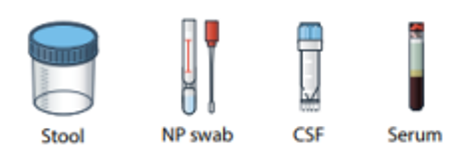
- Note that stool (2 samples collected at least 24 hours apart) should be collected from all patients with suspected AFM to rule out poliovirus infection.
- Additional instructions regarding specimen collection and shipping can be found at: https://www.cdc.gov/acute-flaccid-myelitis/hcp/diagnosis-testing/specimen-collection for-afm.html
- Coordinate with NJDOH to send specimens to CDC for AFM testing. Approval is required by NJDOH prior to submission, and upon approval, specimens are submitted through the NJDOH Public Health and Environmental Laboratory (PHEL).
- Specimens going to PHEL are required to be entered in PHEL’s Online Ordering Portal. If online ordering is not available, a completed SRD-1 form must accompany all specimens sent to PHEL.
- Specimens should be collected while awaiting approval. Collect specimens as close to onset of limb weakness as possible and store as directed (freeze as soon as possible after collection).
- Other routine pathogen-specific testing should continue at hospital laboratories as determined by the patient's clinical picture.
- The following specimens should be collected (in order of priority): stool; nasopharyngeal (NP) or oropharyngeal (OP) swab; CSF; and serum.
- CASE REPORTING: Clinicians should report patients meeting the clinical criteria AND laboratory/imaging criteria for AFM to NJDOH, regardless of any laboratory results.
- Clinical Criteria: an illness with onset of acute flaccid* limb weakness.
- Low muscle tone, limp, hanging loosely, not spastic or contracted.
- Laboratory/Imaging Criteria: an MRI showing a spinal cord lesion in at least some gray matter† and spanning one or more vertebral segments, excluding persons with gray matter lesions in the spinal cord resulting from physician diagnosed malignancy, vascular disease, or anatomic abnormalities.
- Terms in the spinal cord MRI report such as “affecting mostly gray matter,” “affecting the anterior horn or anterior horn cells,” “affecting the central cord,” “anterior myelitis,” or “poliomyelitis” would all be consistent with this terminology.
- Report cases to NJDOH using the patient summary form. Copies of the spinal cord and brain MRI reports, images, and the neurology consult note should be provided along with the patient summary form.
- Reports from possible cases of AFM will be submitted to CDC as part of surveillance to help track AFM, understand the spectrum of the disease, detect outbreaks, and inform research.
- Case classification status (i.e., confirmed, probable, suspect, not a case) is for surveillance purposes and based on consistent and specific criteria to ensure cases being tracked are similar.
- Clinicians should not wait for CDC’s surveillance case classification to diagnose and manage their patient.