What You Need To Know
As reported in the medical literature and news, xylazine is increasingly prevalent in the unregulated drug supply. The toxicologists at NJPIES have been consulted on several cases with significant dermatologic reactions. Below is some information you may find helpful. To get a better understanding of epidemiologic patterns in NJ we ask that you report any potential case to us. Thanks in advance for keeping us in the loop on these cases.
Xylazine Basics:
- Xylazine is an alpha-2 agonist and veterinary sedative that is increasingly being found in the street opioid supply
- Respiratory depression with suspected xylazine overdoses should be treated with naloxone, as xylazine is almost always used with opioids such as fentanyl. Naloxone will reverse the respiratory depression that is from the opioid.
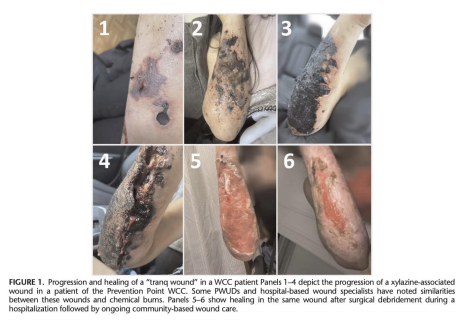
- Xylazine may be associated with the development of necrotic skin wounds (see attached)
- These wounds are often on the arms and legs
- These wounds are often where patients inject drugs, but can also be in locations where patients do not inject drugs
- Patients with signs and symptoms of systemic infection like fever may need intravenous antibiotics
- Patients with signs and symptoms of local infection like increased redness or drainage may need oral antibiotics
Wound Care:
- Pre-medicate the patient as needed for dressing changes, many of the wounds may be painful
- Remove old or dirty dressings
- Irrigate the wound with saline or water
- Apply enzymatic or autolytic debridement to necrotic areas: agents such as Santyl™ or Medihoney™
- If there is extensive and deep necrosis or exposed bone or tendon, surgical debridement may be considered
- Apply a skin protectant to the peri-wound area such as A&D ointment to protect healthy tissue from maceration
- Apply a non-adherent primary dressing to the wound such as Xeroform™ or Adaptic™
- Apply an absorbent secondary dressing such as gauze or abdominal pads over the primary dressing to absorb exudate.
- Secure the dressing
Aftercare:
- Supply patients with equipment to perform daily dressing changes.
- Discuss initiating medications for opioid use disorder such as methadone or buprenorphine • Refer to wound care (or burn center depending on the severity of wound) and addiction medicine specialists for ongoing care
- Please report all suspected cases to NJPIES at 1-800-222-1222
From: “McFadden R, Wallace-Keeshen S, Petrillo Straub K, et al. Xylazine-associated Wounds: Clinical Experience From a Low-barrier Wound Care Clinic in Philadelphia. J Addict Med. 2024;18(1):9-12. doi:10.1097/ADM.0000000000001245”
More information about xylazine can be found from the Philadelphia Department of Health at:
https://www.substanceusephilly.com/healthcare-providers